Waste Fiber Material

Product Videos

What is Waste Fiber Material Recycling?

Waste fiber material recycling refers to the process of reducing, sorting, and conditioning textile and fiber-rich waste—such as fabric offcuts, yarn waste, nonwovens, and upholstery—to recover reusable fiber fractions or to produce size-defined feedstock for downstream applications.

Compared with general solid waste, fiber materials are lightweight, elastic, and prone to entanglement. Effective processing requires controlled cutting, staged size reduction, and precise separation to minimize fluff loss and ensure stable throughput.

Product Videos​

Applicable Fiber-Rich Materials

Material Type Main Components Output / Recovery
Fabric Offcuts & Selvedge Cotton, polyester, blends Size-reduced fiber chips for reuse or fuel
Nonwoven Scraps PP, PET, viscose Uniform flakes, secondary fibers
Upholstery & Mattress Fiber PU foam, polyester fiber, mixed textiles Conditioned fiber fraction, foam chips
Yarn Waste & Cones Natural/synthetic yarns, paper/plastic cones Separated fibers and rigid fractions
Garment Trims with Hardware Textiles with zippers, buttons, hooks Fiber fraction, ferrous/non-ferrous removal

Waste Fiber Recycling Challenges

  • Entanglement Risk:Long, elastic fibers can wrap tools and conveyors without proper cutting geometry.
  • Bulk and Fluff:Low bulk density reduces effective throughput and complicates dust control.
  • Mixed Hardware:Zippers, hooks, and other metals require reliable separation to protect downstream equipment.
  • Consistent Sizing:Downstream reuse demands narrow particle size and low fine loss.

Typical Waste Fiber Recycling Process

  1. Manual Pre-sorting
    Remove large contaminants and non-processable items to stabilize the line.
  2. Primary Shredding
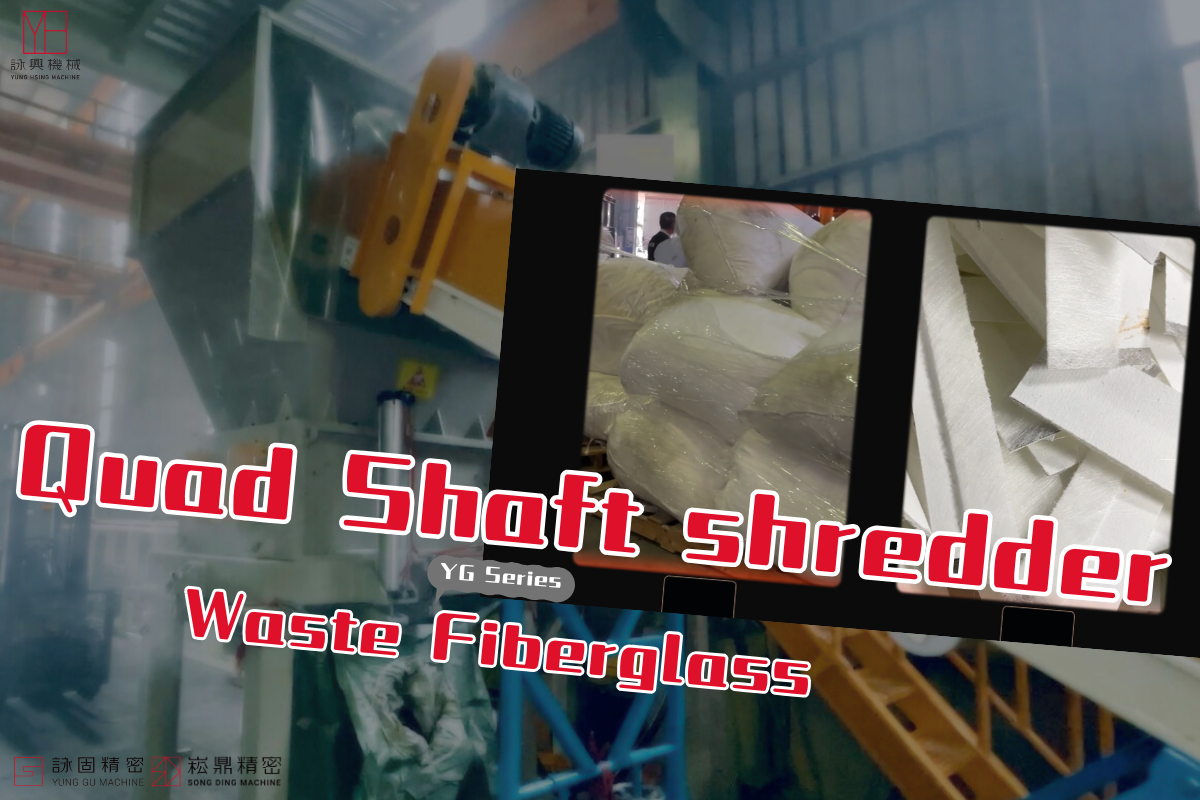
    Open bales and perform coarse size reduction using a Twin-Shaft Shredder or, for complex bulky loads, a Quad-Shaft Shredder.
  3. Secondary Size Reduction
    Achieve controlled chip size with a Powerful Crusher or low-noise refinement via Random Pulverizer.
  4. Screening & Sizing
    Stabilize particle distribution using a Hexagonal Drum Screen and/or a Rectangular Vibrating Screen.
  5. Ferrous Removal
    Remove buttons, staples, and hardware using a Plug-in Magnetic Separator.
  6. Air Classification of Light Fractions
    Separate light fluff and textile fines with an Air-Blow Separator; where density contrast exists, apply a Gravity Separator.
  7. Micro-Pulverizing (Optional)
    For finer end-products or fiber powder, use a Micro Pulverizer.
  8. Final Collection
    Collect sized fiber chips or powder for reuse, compounding, or energy recovery.

Yung Hsing Advantages in Fiber Recycling

  • Stable Cutting Geometry:Equipment optimized to minimize wrapping and ensure continuous feed.
  • Full-Line Integration:From shredding and crushing to screening and air separation with matched capacities.
  • Wear Management:Replaceable blades and wear parts for long service intervals.
  • Flexible Configurations:Modular setups for nonwovens, garment offcuts, upholstery, and mixed fiber waste.
  • Consistent Output:Tight size control and efficient removal of metals and light fluff for high-quality end products.