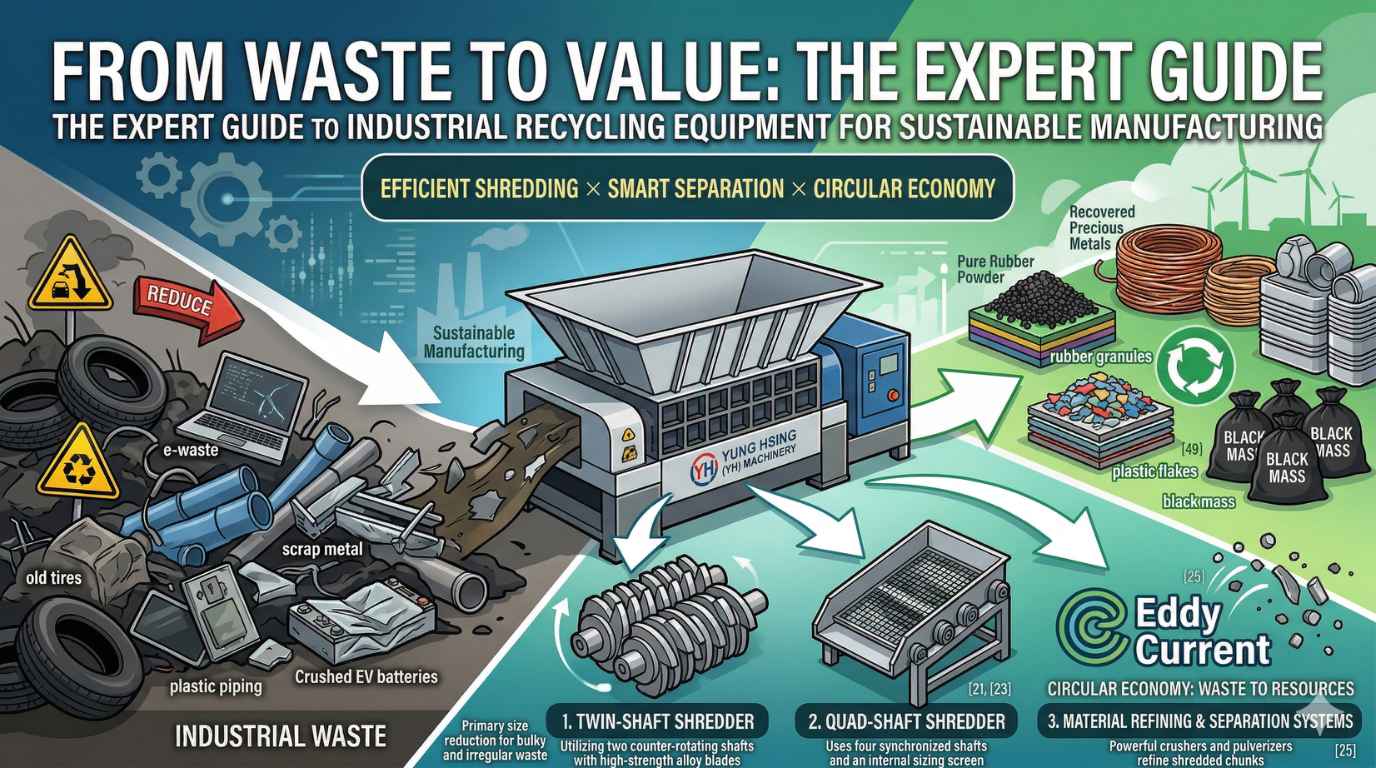
In an era of resource scarcity and stringent environmental regulations, industrial recycling equipment has evolved from simple waste management tools into core infrastructure for resource regeneration. For modern manufacturers, an efficient recycling system is a strategic asset that converts production scrap into high-quality secondary raw materials. The performance of a heavy duty industrial shredder machine serves as the critical starting point, directly determining the purity of material separation and the efficiency of all subsequent downstream processing.
Why Industrial Recycling Equipment is Positioning Itself as Core Infrastructure
Modern recycling technologies are now deployed across diverse industrial sectors to enable “Waste-to-Energy” or “Closed-Loop” circular systems. Primary application areas include:
- E-Waste Processing: Dismantling and recovery of PCBs, communication devices, and household appliances.
- Automotive & Transportation: Shredding of waste tires, aluminum frames, bumpers, and EV power batteries.
- Logistics & Packaging: Size reduction for oversized wooden pallets, HDPE drums, and PP woven bags.
- Manufacturing Scrap: Handling metal offcuts, plastic sprue/purges, and discarded industrial piping.
- Energy Recovery: Processing wood waste or industrial solid waste into Alternative Engineered Fuels (SRF/RDF).
Where These Advanced Recycling Solutions Can Be Applied Across Global Industries
When planning a recycling line, it is essential to understand the functional roles of different machines. Yung Hsing (YH) Machinery provides specialized equipment tailored to specific material challenges:
1. Twin-Shaft Shredder (The “Icebreaker”)
- Role: Primary size reduction for bulky and irregular waste.
- Advantages: The Yung Hsing YH Series twin shaft shredder machine features a low-speed, high-torque design. Utilizing two counter-rotating shafts with high-strength alloy blades, it shears and tears through tough materials like large plastic containers, tires, and metal-embedded scrap with ease.
2. Quad-Shaft Shredder (Precision Size Control)
- Role: Uniform particle sizing and secure destruction.
- Advantages: The Yung Hsing YG Series quad shaft shredder machine uses four synchronized shafts and an internal sizing screen. This ensures material is processed in a single pass to a uniform output size, making it the premier choice for electronic waste (E-waste) and high-security data destruction.
3. Material Refining & Separation Systems
- Role: Fine grinding and purity optimization.
- Advantages: Powerful crushers and pulverizers refine shredded chunks into uniform particles (3-20mm) for pelletizing. Following this, units like Magnetic Separators (for ferrous metals), Eddy Current Separators (for Al/Cu), and Gravity Separators are used to achieve high-purity material classification.
Read More🙁Single, Twin, or Quad-Shaft Shredder?) — Learn the critical differences in shaft configuration, cutting action, and output control to choose the best machine for your material stream.
How to Configure Automated Recycling Production Lines for Maximum Purity
For enterprises seeking high purity and automation, the integration logic between machines is the key to success. Here are three industry-standard configuration examples:
Example A: PCB (Printed Circuit Board) Recovery Line
Targeting the recovery of precious metals and resin fibers:
- Dismantling: Component scraper removes capacitors and chips from the board.
- Primary Shredding: A Yung Hsing Quad-Shaft Shredder breaks boards into 30–50mm fragments.
- Fine Grinding: Powerful crushers and pulverizers grind material into powder to liberate metals.
- Multi-Stage Separation: A sequence of magnetic, eddy current, and High-Voltage Electrostatic Separators achieves metal recovery rates exceeding 99%.
Learn More AboutE-Waste Solutions: ((https://yunghsing.com.tw/en/application/e-waste/))
Example B: Lithium Battery Recycling & High-Safety Line
Targeting high-risk EV and energy storage batteries with a focus on “Black Mass” recovery:
- Safety Pre-treatment: Batteries undergo saltwater discharge and stacking-dry cycles.
- Nitrogen-Protected Shredding: A Yung Hsing Quad-Shaft Shredder with a sealed nitrogen protection system operates in an oxygen-deprived environment to prevent combustion.
- Secondary Grinding: Material is further deconstructed in a sound-insulated mill.
- Separation & Collection: Sealed vibrating screens and dust collectors recover high-value Lithium and Cobalt powder while separating copper and aluminum foils.
Learn More About Battery Recycling: ((https://yunghsing.com.tw/en/article/lithium-battery-recycling-complete-process-esg-equipment-solution/))
Example C: Plastics & Rubber (Waste Tire) Recycling Line
Targeting high-elasticity materials and steel wire extraction:
- Heavy-Duty Shredding: A Yung Hsing Twin-Shaft Shredder performs initial size reduction on large tires or pipes.
- Steel Wire Separation: A specialized Steel Wire Separator removes fine steel beads from the rubber fragments.
- Secondary Granulation: Powerful crushers produce uniform 3–10mm rubber or plastic granules.
- Fiber & Dust Management: Air classifiers remove textile fibers, resulting in pure rubber powder or plastic flakes.
Learn More About Tire Recycling Technology:((https://yunghsing.com.tw/en/application/tire-recycling/)
When to Invest and Who Needs These Critical Procurement Precautions
When selecting heavy-duty equipment, buyers should look beyond simple specifications and focus on these practical operational factors:
1. Feeding Logic & Equipment Protection
- Metered Feeding: Always prioritize uniform feeding via variable-frequency conveyors to prevent chamber blockages or sudden torque spikes.
- Metal Protection: Ensure magnetic separators or metal detectors are installed before fine-crushing stages to prevent structural damage to precision blades.
2. Space Planning & Maintenance Access
- Footprint Redundancy: Allocate at least 20% additional floor space around the line. Yung Hsing’s modular cutting chambers require lateral space for rapid shaft and blade servicing.
- Environment & Compliance: In heavy-duty environments, evaluate whether the equipment includes integrated dust extraction or acoustic enclosures to meet ESG standards.
3. Safety & Regulatory Standards (CE & OSHA)
High-quality equipment must feature comprehensive safety interlocks and automated protection protocols.
- Automated Protection: The PLC system should trigger “Auto-Reverse” and “Emergency Stop” immediately if an unbreakable object is detected or a maintenance door is opened.
- Geometric Safety: Hopper designs must comply with international standards (like ISO 13857) to prevent accidental operator contact with rotating rotors.
Conclusion: Why Customization with Yung Hsing is the Key to Circular Success
In the world of industrial recycling, no two waste streams are identical. Choosing the right equipment is not just about a single machine purchase; it is about finding a technology partner with proven system integration expertise.
With over 30 years of experience, Yung Hsing (YH) provides tailored “Machine-Combo” solutions for PCB, Lithium Battery, and Plastic/Rubber recycling. Through professional material testing and automated line planning, we help enterprises transform “waste” into “new resources,” ensuring sustainable profitability and regulatory compliance in the circular economy.