How to Evaluate the Right Shredder for Your Needs
Selecting the appropriate industrial shredder is a critical decision that directly affects recycling efficiency, system stability, and long-term operating costs. When comparing single-shaft, twin-shaft, and quad-shaft shredders, the differences go beyond shaft count. The real decision drivers are material adaptability, output control, and downstream process compatibility.
Single-Shaft Shredder: The Choice for Precision Output
How It Works
A single-shaft shredder uses one rotating cutter shaft working against a stationary counter-knife. A key feature is the hydraulic ram, which pushes material into the rotor to ensure stable contact and cutting efficiency. Most importantly, a perforated screen installed beneath the rotor controls the final particle size, allowing material to exit only once it reaches the required dimension.
Yung Hsing’s Professional Applications
Yung Hsing’s single-shaft shredders are engineered for applications where output size consistency is essential.
- Typical Applications: Plastic films, pipes, molded scrap, wood pallets, paper, and textiles.
- Process Positioning: Often deployed as “secondary shredders” to provide uniform feedstock for downstream processes like pelletizing or re-melting.
Pros & Cons
- Advantages: Controlled and uniform output size, stable feeding via hydraulic ram, balanced performance for soft to medium-density materials.
- Limitations: Less effective for very hard or heavily contaminated materials; higher blade wear if used for primary crushing of abrasive waste.
Twin-Shaft Shredder: The Powerhouse for Volume Reduction
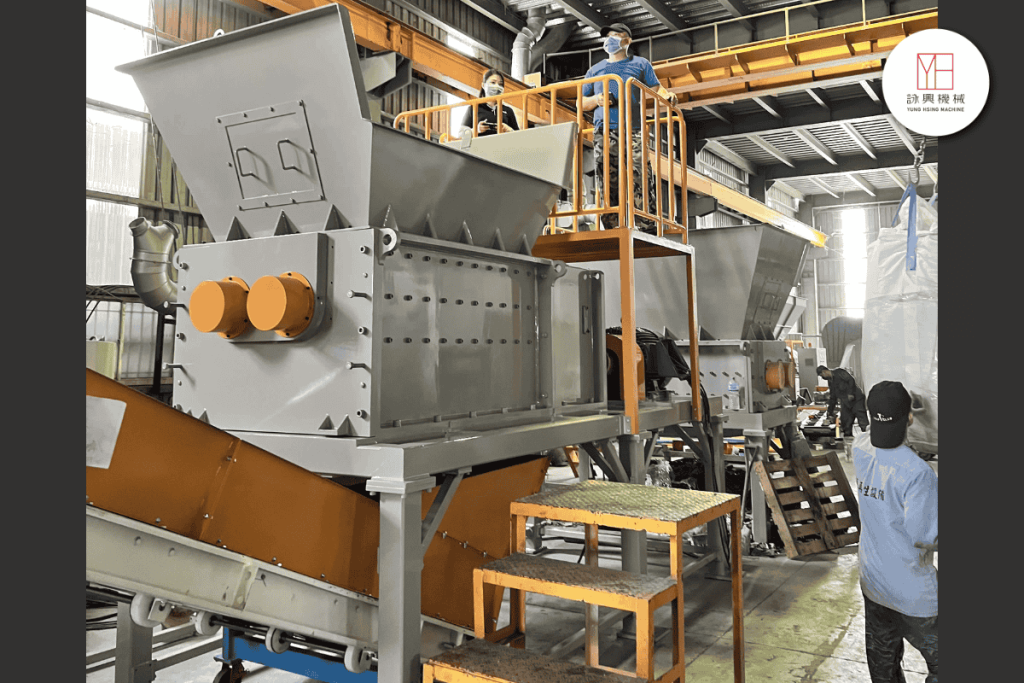
How It Works
A twin-shaft shredder features two counter-rotating shafts equipped with intermeshing cutters. These shafts pull material inward and tear it apart using low-speed, high-torque shearing action. Unlike single-shaft machines, twin-shaft shredders typically do not use a sizing screen; material is discharged once it passes through the cutting chamber.
Yung Hsing’s Durable Design
Yung Hsing’s twin-shaft shredders are designed for durability and continuous operation in demanding environments.
- Typical Applications: Municipal solid waste (MSW), scrap metal, tires, drums, furniture, and construction debris.
- Process Positioning: Ideal for primary size reduction, especially when input material composition is inconsistent, bulky, or unpredictable.
Pros & Cons
- Advantages: High torque capability for tough materials, excellent tolerance for mixed or contaminated feedstock (e.g., embedded metals), simple and robust structure.
- Limitations: Irregular output size (strips/chunks); not suitable for precision sizing without secondary equipment.
Quad-Shaft Shredder: One-Step Fine Shredding & Security
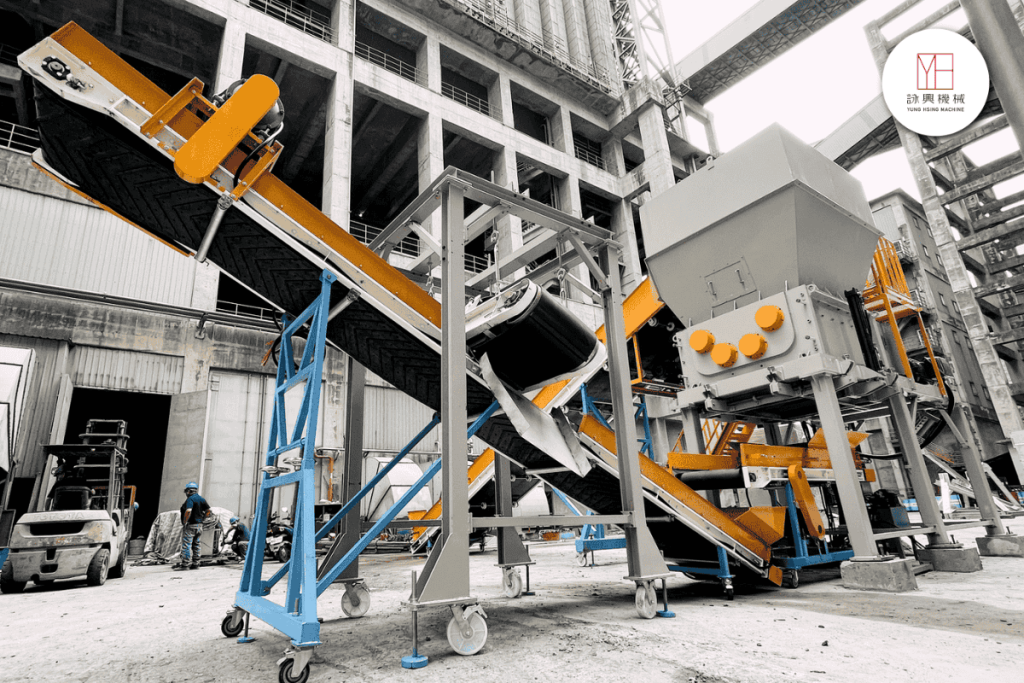
How It Works
The quad-shaft shredder integrates four cutting shafts with an internal screening system. Two primary shafts perform the initial tearing, while two secondary shafts continue shredding and recirculating material until it passes through the screen. This design enables both heavy-duty shredding and controlled output size within a single machine.
High-End & Security Applications
Yung Hsing’s quad-shaft shredders are typically selected for applications where complete destruction and regulatory compliance are critical.
- Typical Applications: Electronic waste (PCBs, hard drives), medical waste, hazardous materials, and brand-protection product destruction.
Pros & Cons
- Advantages: Uniform output size in a single stage, effective load distribution across multiple shafts (reducing jamming), ideal for high-security applications.
- Limitations: Higher initial investment, larger footprint, and higher maintenance complexity compared to simpler models.
Comparison Table: Single vs. Twin vs. Quad Shaft
The table below summarizes the key differences based on critical selection criteria.
| Feature | Single-Shaft Shredder | Twin-Shaft Shredder | Quad-Shaft Shredder |
|---|---|---|---|
| Shaft Configuration | 1 Rotating Shaft + Counter-Knife | 2 Counter-Rotating Shafts | 4 Shafts (2 Primary + 2 Secondary) |
| Cutting Action | Higher speed, shearing & cutting | Low speed, high torque shearing | Low speed, high torque (Multi-stage) |
| Output Control | Screen-controlled (Uniform) | No Screen (Irregular) | Integrated Screen (Uniform) |
| Best For | Plastics, wood, secondary sizing | Bulky waste, metal, tires, MSW | E-scrap, medical waste, strict sizing |
| Key Advantage | Precise particle size | Rugged & contamination-tolerant | One-step fine shredding & security |
| Relative Cost | Medium | Low – Medium | High |
Expert Advice: Designing Your Production Line
In industrial recycling, selecting a machine is not an isolated decision—it is about overall system design.
Key Factors to Consider
- Material Hardness & Contamination: If your feedstock contains mixed metals or unpredictable debris, a Twin-Shaft Shredder is the safer starting point to protect blades.
- Downstream Requirements: If the material must go directly into an extruder or granulator, the uniform output of a Single-Shaft Shredder is mandatory.
The “Combo” Strategy
For complex recycling lines, Yung Hsing often recommends a Two-Stage Configuration:
- Use a Twin-Shaft Shredder for primary reduction of heavy/bulky waste.
- Feed the discharge into a Single-Shaft Shredder for final sizing.
This approach balances throughput, minimizes wear on precise blades, and optimizes long-term ROI.
Next Step: Building the Optimal Solution for Your Plant
Single, twin, and quad-shaft shredders each play a distinct role in industrial waste processing. There is no single “best” machine—only the machine that best aligns with your material stream, operational objectives, and compliance requirements.
By selecting the appropriate configuration, you ensure not just system stability, but also higher efficiency and a better return on investment.
Need Professional Planning?
If you are unsure which configuration fits your specific application, or if you need to test a unique material, contact the experienced team at Yung Hsing Machinery. We can help ensure your selected solution meets both current processing demands and future growth